
The Boiler Upgrade Scheme has made it more affordable for homeowners to move to low-carbon heating. It has expanded in recent years, with more technologies now eligible and funding confirmed through to 2030.
But there is still a fairly significant gap.
A homeowner can receive thousands of pounds towards removing a boiler and installing a qualifying heat pump. Keep that working boiler on the wall and add a heat pump, however, and the support drops to zero.
That is the bit Inta believes needs another look.
The argument is not that a hybrid should receive the same support as a home moving away from gas altogether. Inta believes qualifying hybrid systems should receive a proportionate grant, recognising that the household is still investing in a heat pump and reducing its reliance on gas.
What is the Boiler Upgrade Scheme?
The Boiler Upgrade Scheme, or BUS, is a government scheme covering properties in England and Wales. It provides an upfront contribution towards the cost of installing certain low-carbon heating systems. The homeowner does not receive the grant directly. The installer handles the application and, if the installation qualifies, deducts the grant from the price shown on the quote and final invoice.
At the time of writing, the available grants are:
- £7,500 towards an air-to-water heat pump
- £7,500 towards a ground source heat pump
- £2,500 towards an air-to-air heat pump in a residential property
- £5,000 towards a biomass boiler in limited circumstances
- £9,000 towards an air-to-water or ground source heat pump in an eligible off-gas-grid property replacing an oil or LPG heating system, available until March 2027
Again, the scheme is installer-led, and installations have to meet the relevant eligibility and certification requirements. Funding for BUS has been confirmed through to 2030.
Why don’t hybrid heating systems qualify?
Because under the current BUS rules, the existing fossil-fuel heating system has to be fully replaced.
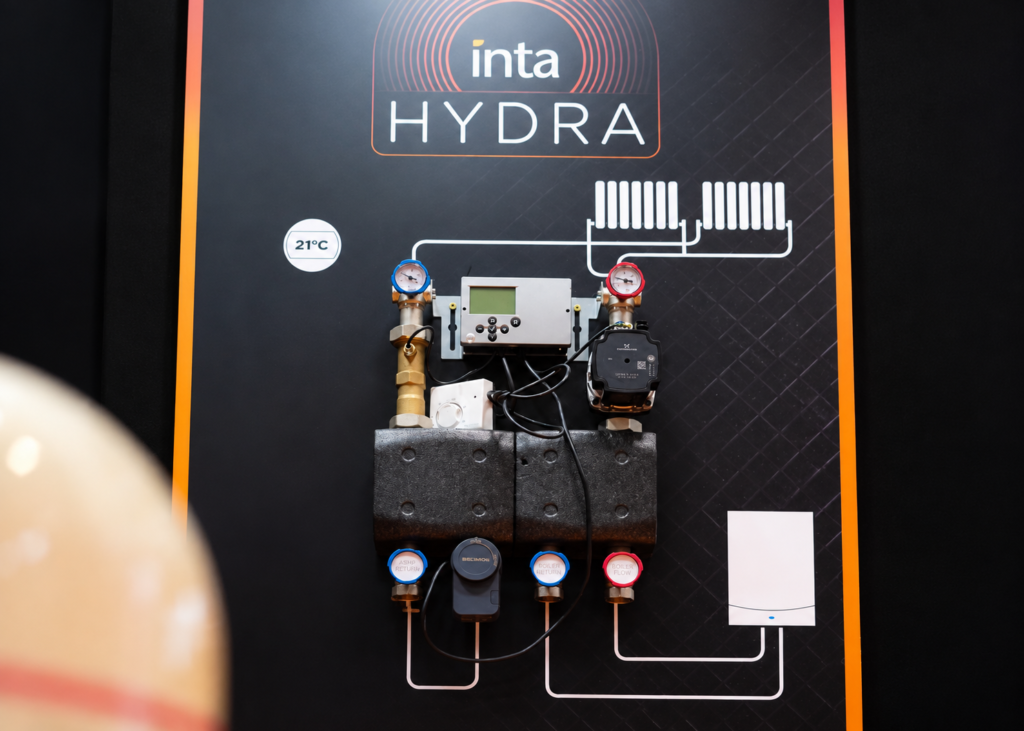
A hybrid combines a heat pump with a boiler. In a heat-pump-led system, the heat pump is there to provide as much of the home’s space heating as possible, while the boiler remains available when it is needed.
That means the boiler stays.
And that is where the current rules draw the line.
Remove a working boiler and install a qualifying heat pump, and the homeowner may receive thousands of pounds in support. Keep the boiler and add a heat pump that could provide the majority of the home’s space heating, and there is no BUS support at all.
For some households, that difference can make a hybrid much harder to justify financially, even where it could start reducing gas use straight away.
Can a hybrid system make a meaningful difference?
Potentially, yes.
Evidence suggests that a heat-pump-led hybrid can displace a substantial amount of gas, although the result will always depend on the property and how the system is designed. Testing carried out for Worcester Bosch at the University of Salford’s Energy House looked at a hybrid system in a replica pre-1919 solid-wall property.
Modelling based on those controlled tests suggested that the heat pump could provide around 94% of annual heat demand. Even when the outside temperature fell to -3°C, the modelling suggested it could still provide more than 70%.
It also indicated a carbon reduction of around 1,270kg per year compared with boiler-only heating.
There is an important caveat.
These figures came from modelling based on controlled testing, rather than a year-long trial in an occupied home. They should not be taken to mean every hybrid installation will produce the same result.
What they do show is what can be possible when the heat pump is designed to lead and the boiler is there to step in when needed.
So why does Inta think hybrids should receive support?
Because for some homes, the real choice is not necessarily hybrid versus standalone heat pump.
It may be hybrid now, or almost entirely gas for several more years.
Britain has a large number of older properties, homes with existing boilers and households where replacing the entire heating system in one go could mean significant cost or disruption.
There will also be homeowners who have fitted a boiler relatively recently and are understandably reluctant to throw away equipment that could still have another decade of useful life ahead of it.
A hybrid offers another route.
It allows a heat pump to be introduced without requiring every part of the transition to happen at once. Radiators can be assessed and upgraded where necessary, fabric improvements can be made over time and the heat pump can take on more of the demand as the property becomes better suited to lower-temperature heating.
Inta is not saying that hybrid heating is the answer for every home. If a property is suitable for a standalone heat pump and the homeowner is ready to move away from gas altogether, its position remains that this is the better option.
Nor does a hybrid necessarily have to be the final destination.
The argument is simply that, for households that are not ready to make the whole change today, it can offer a way to start cutting gas use sooner rather than waiting.
What level of support is Inta proposing?
Not the full £7,500.
Inta supports Worcester Bosch’s proposal for a £3,750 Boiler Upgrade Scheme grant for qualifying hybrid systems – half the standard £7,500 grant available for an air-to-water or ground source heat pump.
There is a logic to that distinction.
A household keeping its gas boiler is not making the same move away from fossil fuels as one replacing it altogether. But it is still investing in a heat pump and, with a well-designed system, reducing the amount of gas it needs to use.
A half-rate grant would recognise both sides of that equation.
There is already something similar elsewhere in government policy.
Under the Clean Heat Market Mechanism, a qualifying standalone heat pump generates one credit for the manufacturer. A qualifying hybrid generates half a credit.
The two policies do different jobs, so they are not directly interchangeable. But their treatment of hybrids is difficult to square.
One effectively recognises a hybrid as making half the contribution of a standalone heat pump. Under BUS, the homeowner receives no support for one at all.
That is why Inta believes a half-rate BUS grant would be a more proportionate approach.
It would not mean steering homeowners away from standalone heat pumps where those systems make sense. It would simply create another route for households that are unlikely to choose full electrification under the current scheme.
If the alternative is waiting years before introducing a heat pump at all, helping those households start reducing their gas use sooner is an argument worth considering.
