
Heat pump retrofits are often discussed as a straight swap: remove the boiler, install a heat pump and move away from gas. But not every property is ready to make that change in one go.
Older housing, an existing combi, limited space and the cost of wider system changes can all make full electrification a much harder sell. That is not reluctance to decarbonise. It is a barrier to adoption.
And if the customer has just spent several thousand pounds on a boiler that could have years of life left in it, why would they rip it straight back out?
That creates a middle ground. Rather than asking whether a property should have a boiler or a heat pump, a hybrid system allows the two to work together, with the heat pump taking the lead for space heating.
The argument for hybrids is not that they should replace standalone heat pumps where full electrification is practical. Intatec’s position is the opposite: in a new home, or an existing property where the customer is ready to come off gas altogether, a full heat pump setup is, of course, the better answer.
The question is what happens to the properties where that is not going to happen yet.
Do you have to choose between a boiler and a heat pump?
No.
A hybrid system allows an air source heat pump to work alongside an existing boiler rather than replacing it altogether. In a retrofit, that means a working combi does not have to come off the wall before a customer can start using a heat pump.
That distinction is important.
The choice doesn’t have to always be hybrid versus standalone heat pump. On some retrofit jobs, it may be a hybrid system now, or several more years relying almost entirely on gas.
A hybrid still uses a fossil-fuel heat source, so it should not be treated as the end point. But it can bring a heat pump into the picture without asking the customer to make every change at once.

How does a hybrid system actually work?
Not every system described as a hybrid operates in the same way.
With Hydra, the principle is heat-pump-first. The boiler and heat pump are not intended simply to split the heating load equally. The heat pump is the lead heat source and is allowed to do as much of
the space heating as possible. The boiler remains available for hot water and to support the system when required, including during peak winter conditions.
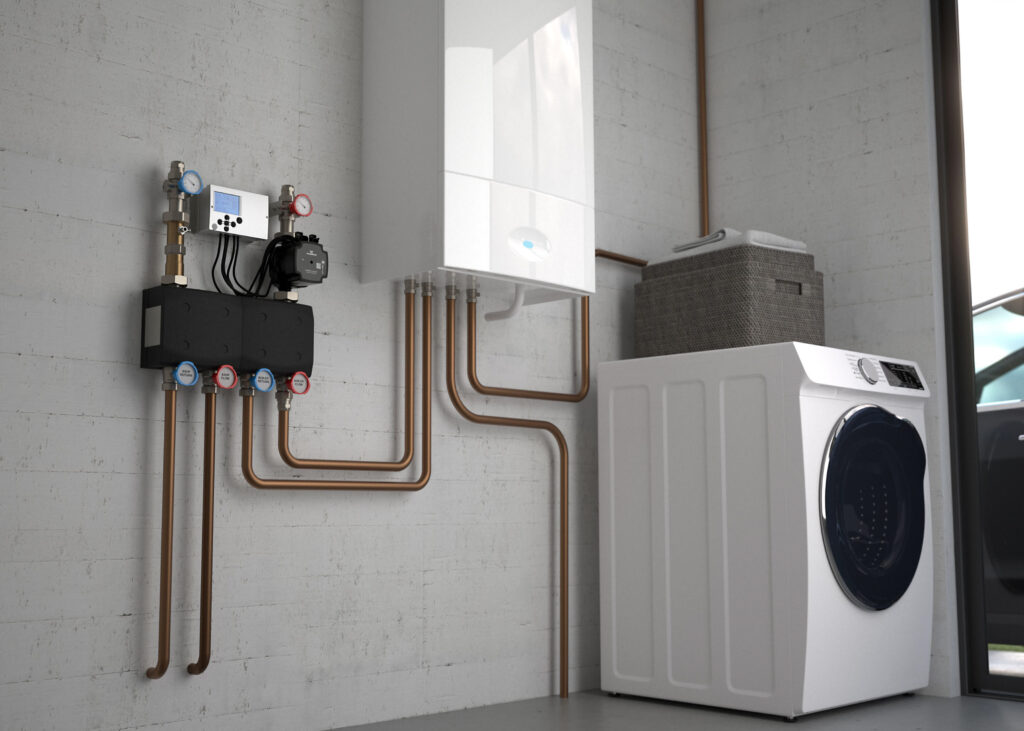
Hydra acts as the link between the existing combi boiler and the air source heat pump. Two pipes are run from the heat pump to the unit, while the existing boiler connects into the hybrid arrangement.
The aim is not to keep the boiler doing most of the work with a heat pump occasionally helping out. It is the other way around.
Evidence discussed during Intatec’s hybrid heating webinar suggested that a well-controlled hybrid can deliver up to 80% of annual space-heating demand through the heat pump.
The principle is fairly simple: use the heat pump as much as possible and call on the boiler when there is a good reason to. The more heating the heat pump provides, the less gas the boiler needs to burn.
Why keep the boiler at all?
Because removing a working boiler is not always the most practical next step.
Millions of boilers currently installed in UK homes may still have years of useful life ahead of them. Expecting every customer to remove one early before they can begin using a heat pump creates a significant barrier to change.
Keeping the boiler gives the system another heat source to call on where it is useful, without making it the default source of space heating.
There is evidence that this can make a meaningful difference. Testing carried out for Worcester Bosch at the University of Salford’s Energy House examined a heat-pump-led hybrid in a replica pre-1919 solid-wall property. Modelling based on those tests suggested the heat pump could provide around 94% of annual heat demand and more than 70% even at -3°C.
There is an important caveat: this was modelling based on controlled testing, rather than a year-long trial in an occupied home. Intatec has itself said it would like to see more real-world data.
That is worth keeping in perspective. A hybrid should not be judged on the assumption that every installation will produce the same result. The split between boiler and heat pump will always come back to the property and the system design.
What happens to the existing radiators and hot water?
Fitting a hybrid does not automatically mean every radiator needs replacing.
Existing systems will often have radiators sized around higher boiler flow temperatures, commonly in the region of 70°C. A heat pump generally operates at a lower flow temperature, so the radiators still need to be checked to make sure they can deliver the required heat output.
What happens next depends on the job.
If the existing radiators are modern and already large enough for the required lower flow temperature, there may be no reason to change them. If they are old and due for replacement anyway, the Hydra installation can be a sensible opportunity to resize them for heat-pump operation.
Budget can shape the decision too. A customer may decide to upgrade the main living areas first rather than replacing every radiator in one go. That assessment should sit within the normal design and pricing process. The installer can determine what output is required and whether the existing emitters are suitable before deciding what, if anything, needs changing.
Hot water is simpler where the property has an existing combi boiler. The combi continues to provide the domestic hot-water requirement.
A property with a hot-water cylinder needs more thought. Hydra is intended for heat pumps up to approximately 10kW, so on a system with a hot-water cylinder, the heat-pump capacity and demand need to be looked at carefully. If the boiler ends up operating much more frequently to meet that demand, some of the benefit of introducing the heat pump can be lost.
What are the drawbacks of hybrid heating?
Hybrid heating will not be the right answer for every property.
The most obvious limitation is that it still retains a fossil-fuel heat source. If a property can move completely away from gas and the customer is ready to do so, Intatec’s own position is that a properly designed standalone heat pump is the better option.
Hydra also has a capacity limit. Its hydraulic design means it is intended for heat pumps up to approximately 10kW output. That needs to be considered at the design stage.
Then there is funding.
Hybrid systems remain outside the Boiler Upgrade Scheme because they retain a fossil-fuel heat source, while qualifying standalone heat-pump installations can receive government support. Intatec and other industry voices have argued for a proportionate level of support for hybrids, but that support is not currently available.
For many projects, that may be the biggest drawback of all. The technology can make sense on paper, but somebody still has to pay for it.
Who is it likely to suit?
Hydra is primarily a retrofit proposition.
It is most relevant where there is an existing combi boiler worth retaining and the customer wants to introduce a heat pump but does not want – or need – to replace the entire heating system at the same time.
That can include older properties, homes where huge system changes would add significant cost or disruption, and customers who want to begin reducing their reliance on gas but are not ready to remove a good boiler altogether.
It does not mean those properties should never move to full electrification. A hybrid can form part of a staged approach – call it a slow burner, but that would be ironic.
Radiators can be upgraded where necessary, fabric improvements can be made over time and the balance between the two heat sources can change as the property becomes better suited to lower-temperature heating.
But specifying one should still begin with the same question as any other heating system: does it make sense for this property?
If a standalone heat pump can meet the requirement and the customer is ready to move away from gas, there is little reason to keep a boiler purely for the sake of creating a hybrid.
If the alternative is leaving an otherwise suitable property almost entirely on gas for another decade, however, the question becomes much more interesting.
That is the gap hybrid heating is trying to fill.
